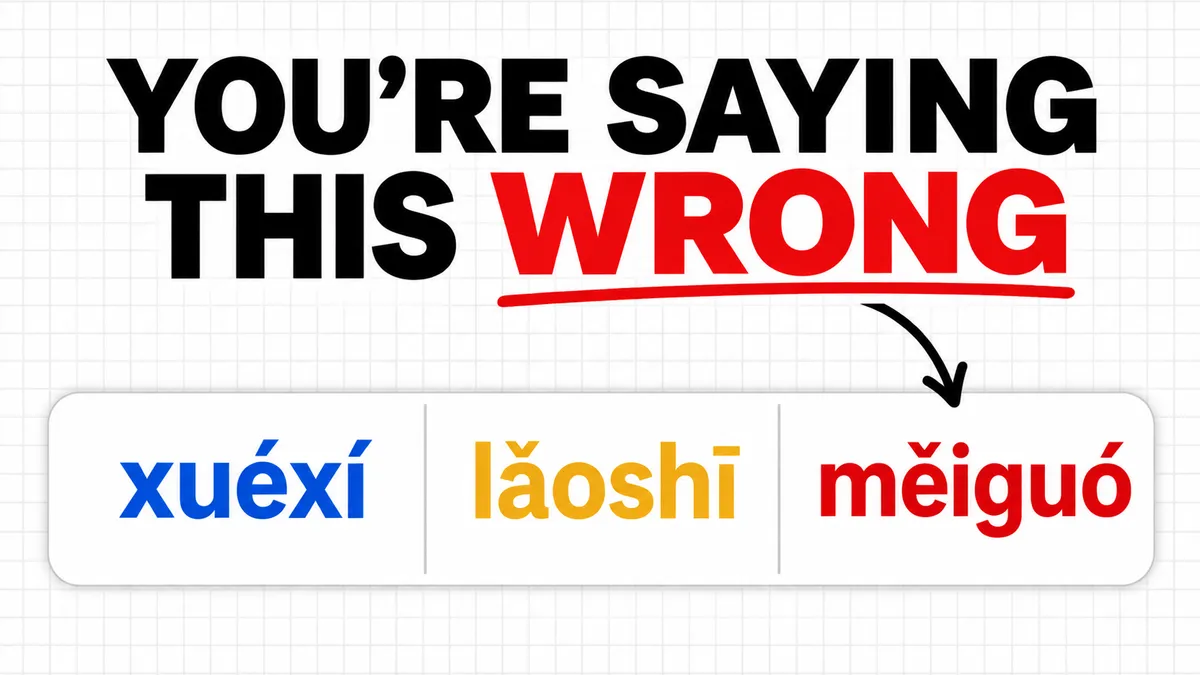
Mandarin Tone Pairs You're Probably Getting Wrong
Most beginner tone lessons stop at four isolated sounds: mā, má, mǎ, mà. That's only half the system. Chinese words are almost always two syllables, which means what you actually say and hear is never one tone alone, it's one tone bumping into the next. That combination is a tone pair, and it's where most of the real difficulty in Mandarin pronunciation lives.
Watch the full video on YouTube →
A quick refresher on the four tones
First tone is high and flat: mā (妈). Second tone rises, like the lift in your voice when you ask "what?" in English: má (麻). Third tone dips low before curling back up: mǎ (马). Fourth tone falls sharply from high to low: mà (骂). Once these feel familiar on their own, the real work starts: putting two of them together.
All 16 Mandarin tone pairs, with real examples
There are 16 possible combinations of tone one through tone four. Here's every one, with a real HSK 1 word so you're practicing pairs you'll actually use.
Pair | Word | Pinyin | Meaning | What to watch for |
|---|---|---|---|---|
1+1 | 今天 | jīntiān | today | Easiest pair, same tone twice. Stay high and flat throughout. |
1+2 | 中国 | zhōngguó | China | Stay high, then find the rise for the second syllable. |
1+3 | 多少 | duōshǎo | how many | Third tone flattens here, it's duōshǎo, not a full dip. |
1+4 | 商店 | shāngdiàn | store | Stay high, then drop straight down. |
2+1 | 学生 | xuéshēng | student | Rise into it, then hold high and flat. |
2+2 | 学习 | xuéxí | to study | Rise, drop to the bottom of your range, rise again. |
2+3 | 苹果 | píngguǒ | apple | Another flattened third. Rise, then stay low and flat. |
2+4 | 学院 | xuéyuàn | institute | Rise then fall right back down. Fairly forgiving. |
3+1 | 老师 | lǎoshī | teacher | Flattened third into a first tone: low, then straight to high. |
3+2 | 美国 | měiguó | America | The hardest pair in the system. Stay low and flat through the third, resist dipping it, then rise into the second. |
3+3 | 你好 | nǐhǎo | hello | Not a flattened third, an actual tone change (tone sandhi). The first tone becomes a 2nd tone: ní hǎo. |
3+4 | 老外 | lǎowài | foreigner | Flattened third, then a sharp drop. |
4+1 | 大家 | dàjiā | everyone | Full drop, then straight back up to high and flat. |
4+2 | 外国 | wàiguó | foreign country | Drop, then rise, the mirror of 2+4. |
4+3 | 自己 | zìjǐ | oneself | Drop, then flatten into the third. |
4+4 | 再见 | zàijiàn | goodbye | Two falling tones back to back. One of the easiest. |
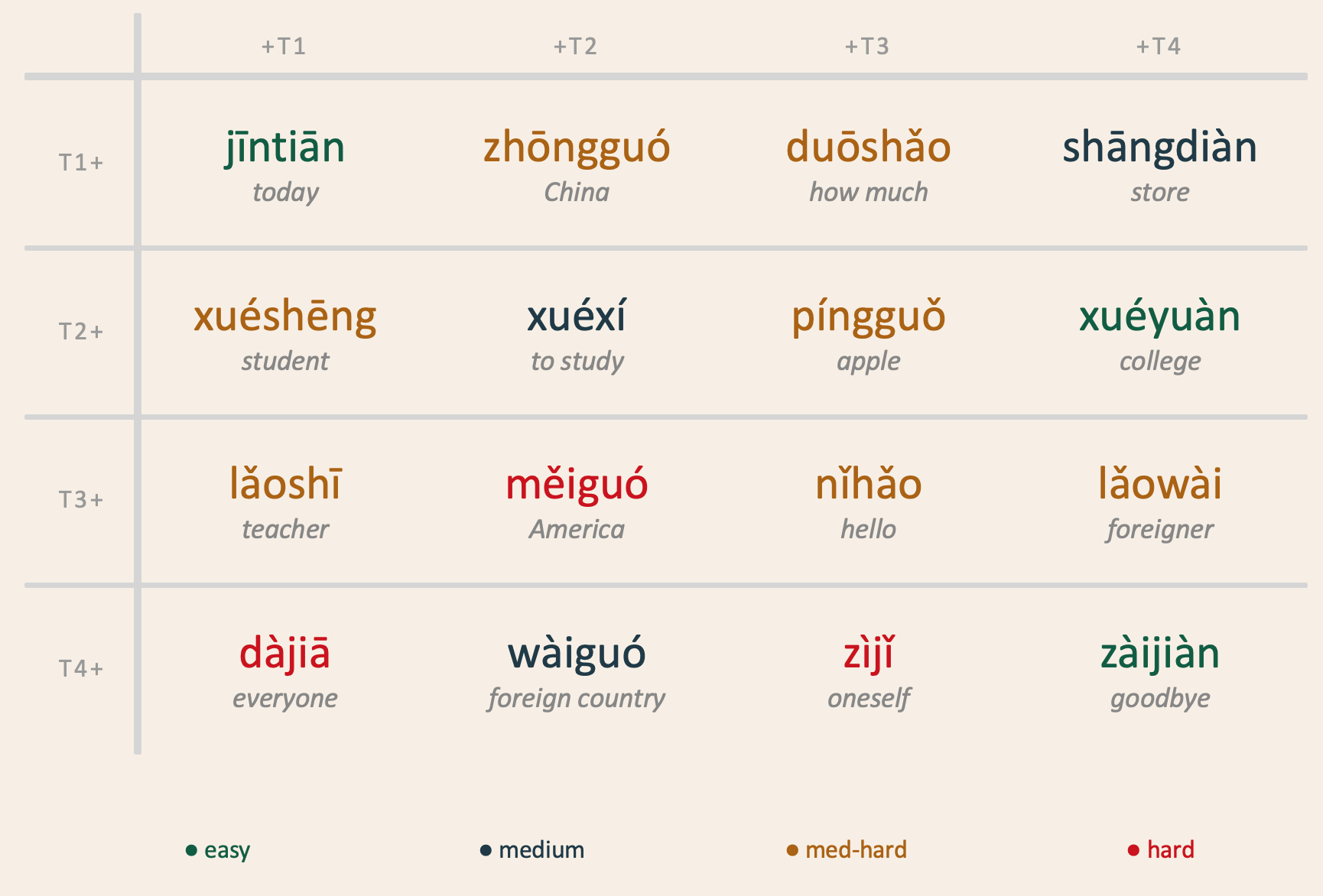
Screenshot this chart and keep it for practice.
The third tone almost never sounds like the textbook version
Notice how often the third tone flattens instead of dipping in the table above. In isolation it dips and rises, mǎ. Next to almost any other tone, it just stays low and flat. That's the version you'll actually hear in real speech far more often than the textbook dip.
Why nǐhǎo isn't what it looks like on the page
你好 looks like two third tones stacked together. It isn't said that way. This is tone sandhi: the first syllable actually changes to a second tone. Said correctly, it's ní hǎo. Said as written, two flat low tones back to back, it sounds off to a native ear.
Which pair should you drill first?
Start with 3+2, using měiguó. It combines the flattened third tone with the rise into a second tone, the two hardest individual moves in the system, in one word. Blake, who built Red Bamboo Foundations, has spent 10+ years learning Mandarin, including four years living in Shanghai, and holds an HSK 4 certification. He'll tell you 3+2 is still the pair he has to think about the most.
Practice these pairs, not just the four tones
Red Bamboo Foundations covers all 16 pairs plus tone sandhi rules like the one above, inside Module 13: Tone Mastery, with a pre-assessment and post-assessment so you can see your own progress.
RED BAMBOO FOUNDATIONS
Build a real foundation in Mandarin tones and pronunciation
Structured lessons, tone pairs rated by difficulty, and a pre/post-assessment so you can see your progress for yourself.
Prefer to practice out loud and get instant pitch feedback? Try the Red Bamboo Chinese app → It listens to you say these exact pairs and tells you which tone you actually produced.