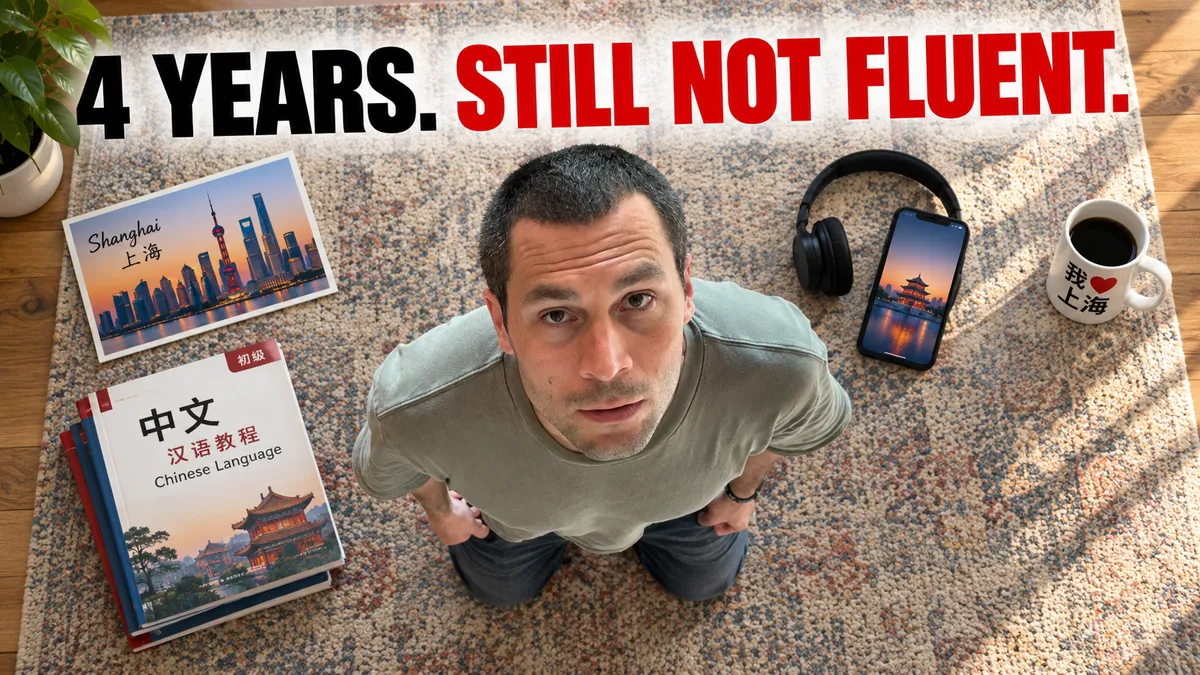
Why Living in China Didn't Make Me Fluent in Mandarin
I lived in Shanghai for four years and still wasn't fluent in Mandarin. If you're hoping a move abroad is what'll finally get you there, here's what actually kept me from it, and what I'd do differently.
Watch the full story on YouTube →
Moving somewhere won't make you fluent by itself
A lot of learners believe that if they could just move to China, fluency would follow naturally. I believed it too. I lived in Shanghai for four years, and it didn't happen. Two specific things kept me from it, and neither one was about the country itself.
The foreigner bubble
Why does this happen? The moment you move somewhere completely foreign, your Chinese isn't good enough yet to handle cell service, an apartment, groceries, or a hospital visit if you need one. So you find people who speak your language to help you figure it out. You get close to them fast, because you're navigating a new country together. You end up celebrating Thanksgiving and Christmas with them, since those holidays aren't really celebrated in China. Before long, you're living inside an English-speaking bubble in the middle of China.
This isn't unique to China. It's the same reason Chinatowns, Koreatowns, and Little Italys exist everywhere. People cluster by language.
The fix is direct: get uncomfortable on purpose. Have the awkward conversation with a coworker or a neighbor. Get a tutor so you're not only surrounded by English speakers.
Embracing the cringe
Here's a small example. I'm back in the US now, and I went to the dentist recently. My hygienist's last name was Guo, so I asked her, in Chinese, if she was Chinese. She replied back to me in Chinese. That one question turned into a real conversation, about her background and mine. I'd have missed it completely if I'd just stayed quiet or too embarrassed to start the conversation.
Why "good enough to survive" is actually the dangerous point
The second thing is what happens after you get good enough to survive. Once you can handle numbers, give a taxi driver directions, and order at a restaurant, it's tempting to stop pushing. That's exactly where I landed in China. I'd passed HSK 4 by then, but I was still nervous to strike up a conversation with a stranger, especially as an introvert. I had the whole country at my fingertips, and I took it for granted, because I was afraid of making a fool of myself.
Don't be like me.
Does living in China actually make you fluent?
No. It's still a good goal to have. Moving to Shanghai changed my life, and I'd consider moving back someday. But it didn't make me fluent by itself.
You don't need to live in China to become fluent, and living there doesn't guarantee it either. The days I actually moved forward were the ones where I tried a new phrase on a stranger instead of staying quiet. That's still the choice, today and tomorrow, one day at a time.
If you want the fuller story of my ten years with this language, including the three times I quit entirely, I wrote about that here.
What actually helps
Foundations won't make you fluent either, and it's not trying to. What it gives you is the mechanics: tones, pronunciation, initials, finals, tone pairs, tone sandhi, the specific syllables that trip up most beginners, so the words you do say come out right. The rest, the conversations, the awkwardness, the daily choice to try, is still on you.
RED BAMBOO FOUNDATIONS
Get the mechanics right before you need them in a real conversation
14 modules, 66 lessons, under 4 hours of video, plus a one year subscription to the Red Bamboo Chinese app. Retail is $127, first 50 students pay $50 with code FIRST50.
Prefer to practice out loud first? Try the Red Bamboo Chinese app → It listens to your pronunciation and tells you exactly what sounds you're making, free up to 25 times.