Pinyin Chart Explained: Sounds Beginners Get Wrong
Pinyin uses English letters, but the x in pinyin doesn't sound like the x in "box." Here's the pinyin chart one sound at a time, with the mistakes beginners make most.
Watch the full video on YouTube →
Why learn the pinyin chart before characters?
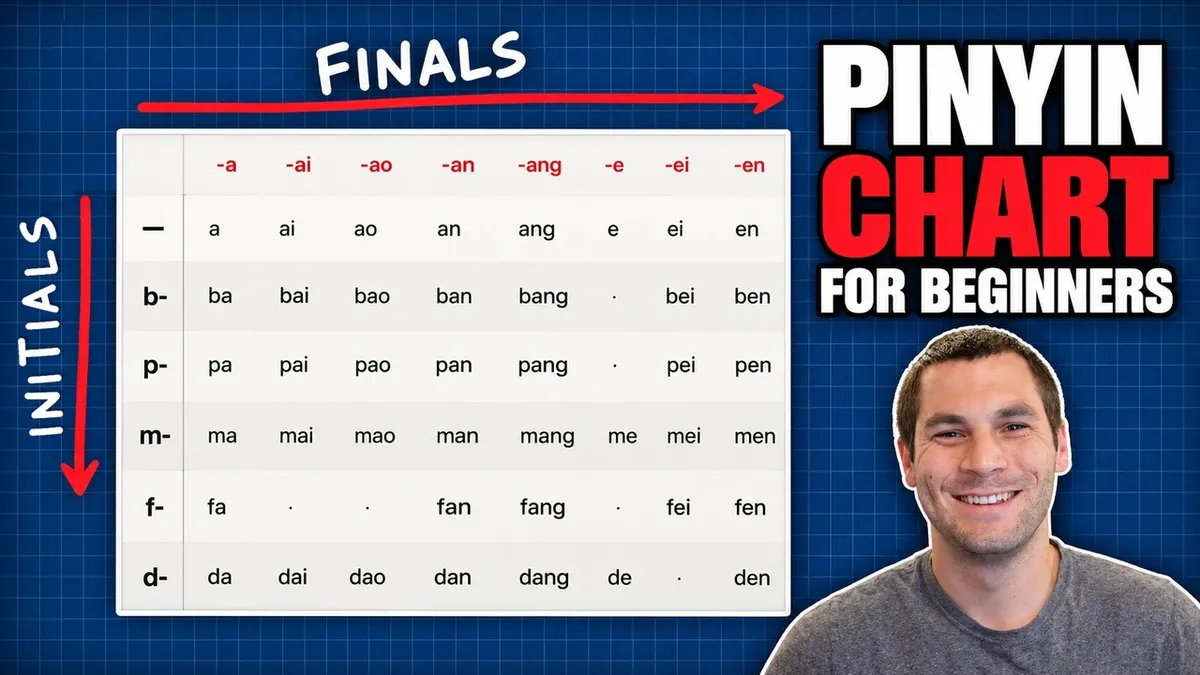
Many learners skip pinyin and jump straight into memorizing characters. As a result, they can stay confused about how certain words sound for months, or even years. The chart helps because it puts the sounds Chinese makes in one place, so you can see where your gaps are. Most of the sounds in Chinese are on this one chart, written in romanization.
You can download the chart as a PDF here and follow along.
How to read the pinyin chart
The initials run down the left side. The finals run across the top. An initial and a final come together to make a syllable, and that syllable matches a Chinese character. Almost always, one character is one syllable, and two syllables can come together to make a word. That's all the chart is doing.
Some syllables have no initial. Those sit in their own row, and they're spelled with a y or a w in front, like yi and wu. You'll also notice an asterisk on one of the i finals on the chart. We'll get to that.
The sounds that transfer easily from English
Start with the initials that are close to English: b, p, m, f, d, t, n, l, and then g, k, and h. Say them with a, and you get ba, pa, ma, fa, da, ta, na, la, ga, ka, ha. These initials will be your friends, because the sound moves over from English with very little change. Then try them with more finals.
The finals: vowel clusters
Across the top, the finals come in families: the a's, the e's, the i's, the o's, and the u's, including a u with an umlaut. They're basically vowel clusters, which is a little familiar from English vowels. Some are close to what you'd expect: an a for the a sound, ai, an, ang. The e final is further from English, so don't assume it sounds like the English letter e. The ou final is like the long o in English, and ong sounds like the o in "dong."
When an i final has no initial, it gets the y spelling, like yin and yong. The u finals work the same way with w, like wa and wai.
The u with an umlaut
You already know bu, which means "no." Now add the umlaut and you have ü, a different sound. To make it, tighten your lips quite a bit and push air through them, like in lü, down in the corner of the chart.
Here's the surprise. With j, q, and x, the two dots disappear in spelling, but you still make the ü sound. So xu is read with ü, even though it's written without the umlaut. It's a visual cue you just have to know.
The tricky initials: j, q, x
These three aren't made with the same tongue position as in English, and that's where an English speaker's accent really comes out. Put the tip of your tongue down behind your bottom front teeth, and raise the middle of your tongue. Then try ji, qi, xi.
Some of you will hear those as the same sound, which is why they're grouped as a cluster. They're very similar. One difference to notice is that qi takes a bit more force, because you're pushing more air through the shape your tongue makes.
A common mistake is the word for thank you, xie xie. Some learners say it like "shie shie," because they haven't learned to make the x. The accent comes from the tongue and mouth being in the wrong position.
The next trio: z, c, s
These three sound similar to each other, like j, q, x, but the tongue position moves. Put the tip of your tongue behind your top front teeth. A trick: say the English letter n, and notice where your tongue lands. That's the position for z, c, and s.
On the chart, c is written as a single letter, but the sound is like the ts at the end of "cats" or "hats." S is close to the English s. Try za, ca, sa, and see if you can hear the difference between the three.
The final boss: zh, ch, sh, and r
These are the hardest initials for most English speakers. They also explain the asterisk on the i column, because the final that follows them is a little different too. For zh, ch, and sh, the tongue goes even farther back than for z, c, and s. Your tongue curls up and partly blocks the air as it comes out. The r row is made in a similar position.
They take a lot of practice. I go through every sound in these rows in detail in Foundations, with each tone.
What the pinyin chart doesn't cover
The chart shows how a syllable is pronounced, whether it's first tone, second, third, fourth, or neutral. It tells you nothing about tones. That's a separate step, and my post on tone pairs is a good place to go next.
How to practice with the chart
Learning characters means understanding how to read a character, how to write it, how to pronounce it, and how its tone works. That's a lot at once. Do it in shorter steps instead. First, how do I pronounce it? Then add the tone. Then add reading it. Then add writing it.
Go through the chart and try to say each sound as well as you can. You can go across the rows or down the columns. As a beginner, this chart should be your best friend.
The Red Bamboo Chinese app can check you. It shows the pinyin, the character, and the definition. You tap record, say the word, and it tells you whether your pronunciation was correct. You can also hear my example audio and compare it with your own. It's free to try up to 25 times, no credit card required. Five minutes a day of this will make you more confident in your pronunciation.
A few common questions
What is the pinyin chart?
It's a table of the sounds in Mandarin written in romanization. The initials run down the left side and the finals run across the top. Combine one of each and you have a syllable.
Should I learn pinyin before characters?
I recommend it. If you learn pronunciation first, you only have one thing to focus on, and adding characters later is much easier than learning how to read, write, pronounce, and tone each one at the same time.
RED BAMBOO FOUNDATIONS
Every initial, every final, and every tone on the chart
66 short video lessons, plus a one year subscription to the Red Bamboo Chinese app.
Want to test your pronunciation first? Try the Red Bamboo Chinese app →